East Meets West

Saturday, March 24, 2007

ISTANBUL AU NATUREL

A great thing about Istanbul is despite the fact that there are over 20 million people living here, you don't have to go very far to find nature.

And now that spring has sprung, it's completely in my face. Not that there has been a lack - the winter was so warm that my plants just took a disco nap instead of hibernating! But now that March is here, Mother Nature is putting on a spectacular that can only be compared with Carnival in Rio:


Blossoms are exploding on trees. As I watch the skyscrapers pass by on the way to work, my attention gets pulled to trees I hadn't noticed before that have turned fluffy pinks, yellows and white.

Cats were just fighting during the warm winter. Now the screeches have turned to purring as felines everywhere have taken to courting and many a swollen belly can be seen waddling around our neighborhood. Soon the place will be 'litter'ally crawling with kittens!

Besides a great view of a construction site outside my window there are birds that visit me throughout the day. (I'd like to think they're visiting me - they're probably just checking out their reflection in the window!). They've been busy this week hauling twigs, cotton and pieces of paper to the floor above us where they are building a nest and there soon will be baby birds chirping away. This guy (right) was struggling to carry the equivalent of an avian chandelier up to his new pad. I could just picture the missus shaking her head and saying 'I told you that will never go with the designer newspaper and spittle sofas!'

Ah yes, it's great to be so close to nature. I'm just thankful that my work neighborhood is far from my home, where baby birds would be a tasty treat for all the newborn kitties. A side of nature I'd rather not witness!

Labels: ,

Saturday, January 13, 2007

ONE LUCKY SHEEP?

A couple weeks ago we celebrated Eid Al Adha – the Feast of the Sacrifice in Turkey. Turks practice many pagan rituals that have been adapted to Islam and/or modern Turkish culture, and the sacrifice is one example.

Apart from this holiday, folks sacrifice animals throughout the year to celebrate, give thanks and to bring good luck. When the last of a troublesome model of planes was sent back to the UK by Turkish Airlines, some of the workers celebrated by sacrificing a camel
at the airport. A friend of mine refused to sacrifice an animal when they bought a new vehicle for their business and the van had several accidents and incidents throughout the year.

This year Mahmut and his family sacrificed a sheep. A prayer is said to the animal, the butcher makes a quick slit to the throat, the animal is carved up and some of the meat goes to the family and the rest to the poor.

I love my meat – be it a nice steak, some lamb chops or a sizzling shish kebab. I also don’t get queasy easily. But when they brought back the meat and Mahmut’s 10 year old nephew called out ‘it’s still warm!’ I had to leave the room. I didn’t want to be the sissy foreigner, so I popped my head into the kitchen from time to time while they were carving the meat into more manageable pieces. I was able to tolerate the concept more, until Mahmut’s Mom called me over to show me something ‘Look at this! The vein is still throbbing!’. They finally had to leave the meat on the balcony to cool down because, as I learned that day, warm meat is more difficult to cut than cold meat.

Needless to say, I didn’t take any lamb home with me, and it was a few days before I could stomach a piece of meat. I will still have my steak any day – just don’t remind me where it came from!

Labels: , , ,

Tuesday, December 19, 2006

ANCIENT TRADITION GOES MODERN

December 31st is just around the corner and you know what that means. Well, this year it means Kurban Bayram in Turkey - the Holiday of the Sacrifice.

Once upon a time there was a guy called Ibrahim (Abraham). He was asked by God to show his devotion by sacrificing one of his sons. In Christian tradition, that son's name was Isaac. According to Islam it was the other son, Ismail that was to get the axe. Ibrahim did what he was told and at the last moment, his son miraculously turned into a lamb.


To commemorate this miraculous event, Eid el Adha is celebrated every year. It also marks the end of the Haj Pilgrimage to Mecca. Families that can afford to have an animal sacrificed to give thanks to Allah, and the meat is given to the poor. It has come to my attention that this ancient tradition has taken on a very modern twist in Turkey.

According to my friend Lucy, it's a major PR coup if a hypermarket (giant supermarket) becomes the site of the neighborhood's sacrifices. Not only do they get hundreds of people visiting their store during the holidays, they also build up good will with the locals. Take Carrefour for example. In some cities they build a huge pit in their parking lot to help with the sacrificial draining. They set up an area for the animals. They offer a 'sacrifice package' - you pick out your animal, and they will house, feed, take care of and slaughter it for you. And you can pay for your holiday package with a credit plan of 6 installments! I don't think Allah saw that one coming when he did the ol' switcharoo on the mount...


My colleague Gamze found another convenient way to give thanks during the holiday season -
www.aloadak.com. Like choosing a hottie from an online dating service, you can pick out your sacrificial lamb over the internet, make arrangements for the sacrifice and pay online. According to the site "Those who don't have time to go to the Animal Market can call our Hello Sacrifice hotline or contact us through our website for all your sacrificial needs." No fuss, no muss, settle your holiday duties with just one phone call!

I wonder if there's an online confession service for Catholics...

Labels: , , ,

Friday, October 20, 2006

10 REASONS I LOVE RAMAZAN

Ramazan (or Ramadan as it's known in most of the world) is the Islamic month of fasting, and is about to come to an end this year. Here are some of the reasons why I love Ramazan:

1. Food tastes better after not having eaten all day
2. You can walk through the streets without being asphyxiated by cigarette smoke
3. 1.5 billion people world-wide experiencing the same struggle of not eating food
4. When you don't eat during the day, you realize how much your life revolves around food
5. When you don't eat during the day, you realize how much more efficient you can be without having to take food breaks

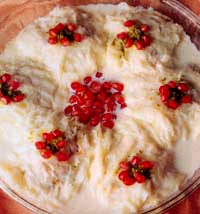
6. Gullac! During Ramazan in Turkey, this favorite dessert of thin layers of dough, milk, nuts and pomegranate seeds is available.
7. 1.5 billion people feeling empathy: One of the purposes of fasting during the month is to understand what those without go through every day
8. 1.5 billion people feeling compassion: Ramazan reminds people to be more compassionate towards others. Drivers are less aggressive, people are more courteous and thoughtful than they are at other times of the year
9. Less traffic during rush hour. Folks rush home or to restaurants before iftar, the breaking of the fast. This year, iftar takes place around 6:30pm - the perfect time to leave the office as the streets become empty.
10. Sugar Festival! Seker Bayram is the 3-4 day holiday after the month of fasting. A combination of Christmas, Halloween and Chinese New Year, children get presents, new toys and lots of candy. They also go around kissing their elders' hands then touching them to their forehead, a sign of respect. In return the elders give them money, similar to children receiving red envelopes on Chinese New Year. During the Sugar Festival, friends and relatives are visited and lots of food is eaten to celebrate the end of fasting.

Happy Holidays!

Labels: , , , , ,

Sunday, September 24, 2006


WHO WANTS TO BE AN ORYANTAL STAR?

Last night we watched the final round of the latest reality show to hit Turkey. It’s not a repackaged, localized version of Big Brother or Survivor or American Idol. This reality program has a very local twist to it.

What do you get when you take 11 young women with various levels of talent, stick them in a hotel and give them dance lessons all week, then dress them up in exotic costumes so they can strut their stuff on stage? Oryantal Star is a home-grown reality program where contestants learn a new style of belly dancing (known as ‘oryantal’ or oriental in Turkish) every week, then perform it on Saturday night during a live broadcast all over Turkey (and Germany via satellite). The dancers have learned styles such as Romani (Gypsy), North African, Balkan, Arabic, Techno and of course Turkish. The home audience votes via SMS for their favorite dancer.

Which begs the question – Who wants to be an Oryantal Star? Not in the ‘Who wants to be a millionaire’ sense, but really – after winning the title what’s next?

Turkey is one of several countries around these parts famous for belly dancing. On many a tourist’s top 10 things to do while in Turkey, going to a belly dance show is one of them. I was taught that belly dance is an art, a celebration of womanhood, and that the dancer is not some street tart, but somebody to be respected. And this argument can hold true in certain countries where belly dancing doesn’t have a long history, and where women are on more equal standing with men. But shimmying, scantily-clothed women are not seen as artists in a country where men from all walks of life, as if hungry wolves, look at women like innocent lambs just waiting to be devoured. The dancer is an object to be ogled and leered at, not somebody to be revered. On top of that, belly dancing is seen as being related to prostitution, as some dancers offer dancing and more. So while Turks like to watch the belly dancer perform, they don’t want their girlfriends, wives or sisters to be the belly dancer.

And unlike singing or acting contests, there’s not an obvious next step for the winner of Oryantal Star. Dancers may perform at private parties, cultural shows, on women’s daytime programs and evening variety shows on TV. But unlike singers or actors, there’s no recording contract to land, no film role to act in, no guarantee of regular work.

When asked what their next step would be after winning, the finalists were not even sure what they would do. ‘Keep practicing’ ‘Improve my Turkish’ ‘Help poor people’ . Nobody had a clear idea of where their career as a belly dance star would lead them in 10 years.

I think the producers of this show are to blame for not explaining what the contestants can expect from a life of belly dancing. If the show is meant to improve the image of belly dancing in the public's eye, then there should also be a clear career path spelled out. Indeed, Tanyeli, the belly dancer judge of the show, and Asena (another very famous Turkish dancer) – are even changing their tune and seem to be working on their singing careers at the moment to be able to branch out from dancing alone.

It takes courage to break down stereotypes, and for that I tip my hat to all the contestants who went on stage every week to be judged by thousands. And the concept has caught attention elsewhere, with other countries wanting to run local versions of the program. I personally feel it’s a great way to showcase the rich variety of dancing that there is, and I hope that the show succeeds in raising the status of belly dancing to an art form so it can pave the way for other women wanting to carry on this ancient tradition
.

Labels: , , , , , , , , ,

Sunday, May 14, 2006

MARDI GRAS COMES TO ISTANBUL

On 5 May, while most of the world is eating triangular corn chips and sipping alcoholic slurpees, and on May 6 when most folks are recovering from the events of the 5th, people all over Turkey are celebrating spring and the coming of summer. The festival is called Hidrellez, and has been taking place in these parts since ancient times. Just as this festival has touched many cultures, there are many different takes on what the festival represents.

Pagan Hidrellez: That last chill of winter is leaving, signaling the advent of summer, so why not skip around a maypole and roll in the clover with your neighbor?

Muslim Hidrellez: The day when the prophets Hizir (Khidir) and Ilyas (Elias) met on earth to awaken spring, which is where the name comes from (Hizir+Ilyas=Hidrellez)

Ahirkapi Hidrellez: A great excuse for a neighborhood party! The neighborhood I work in is full of gypsies. So of course the festival that they celebrate has a flare to it like no other. Combining music, food and folklore, Ahirkapi’s Hidrellez festival is becoming something of a mini Mardi Gras in Istanbul.

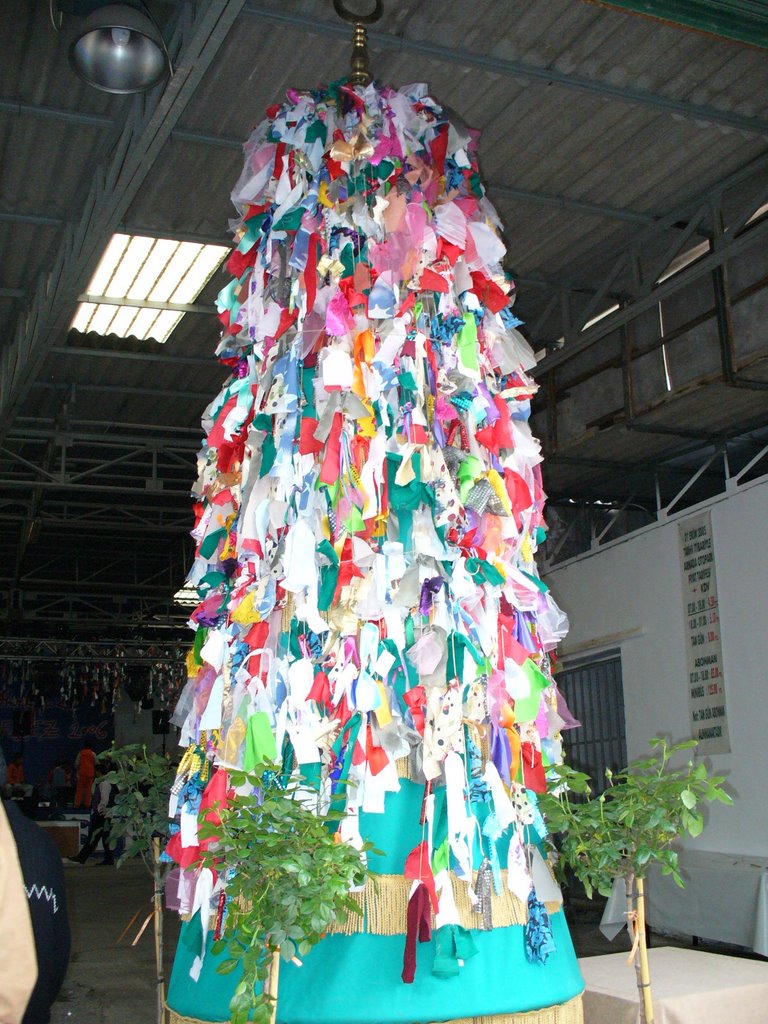
The prophet Hizir is a symbol of spring and is believed to pay us an earthly visit every year at this time, increasing people’s prosperity and helping people out in general. I think he visited us on the 5th-there were a couple knocks at our door, but when we went to open it, we couldn’t see anybody. Around the neighborhood there are loads of symbols of luck and hope-sidewalk stones painted like ladybugs, ‘wishes’ (pieces of cloth) tied on strings hanging from buildings, and in the center of it all a nahil tree where people stick their wishes that they’ve written on paper.

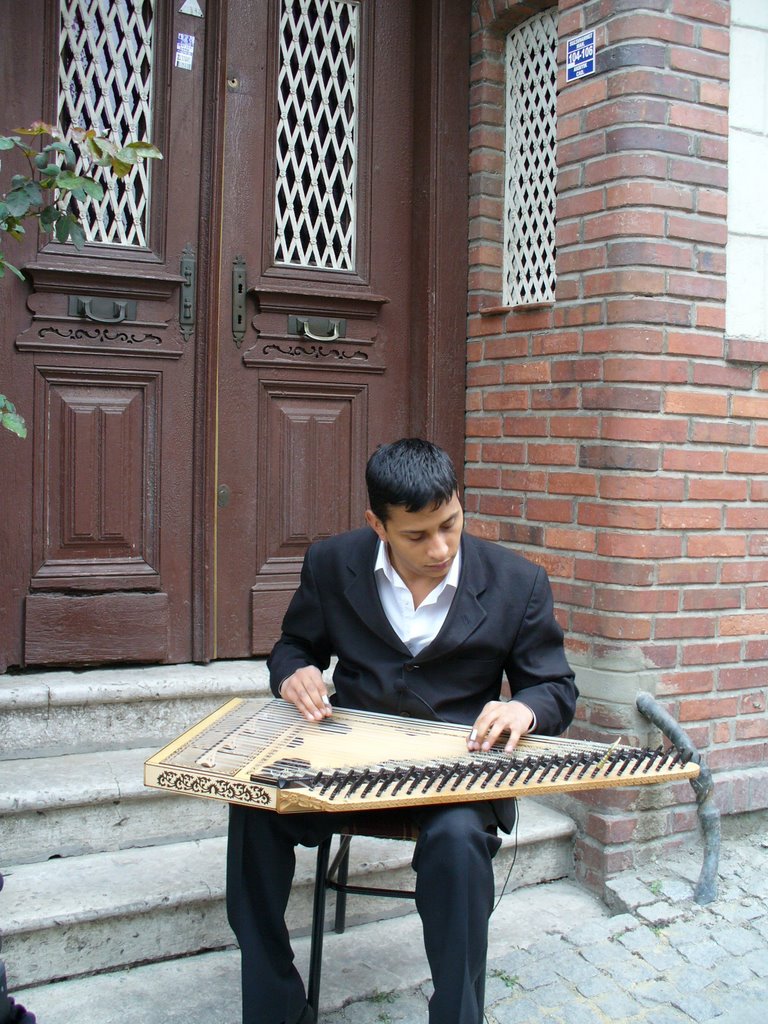
We could hear the neighborhood Romani (gypsy) band practicing in the café across the street a few days before the festival, and I instinctively found my feet tapping and my hips swaying to the music. Luckily they don’t play more often or I would never get any work done!

During the festival our neighborhood band, along with several other local and international groups, play on stages set up around the neighborhood. And when you think you’ve found a great back street that’s a short cut, you will no doubt stumble across some of these musicians who, after playing on stage, are jamming impromptu for neighbors and passers-by. We even saw a mini percussion party with a guy playing his davul, his 3 year old son echoing his beats on his junior davul while the neighbors sat around outside their front door clapping and dancing to the rhythm.

If you’re in Istanbul at the beginning of May, you shouldn’t miss this unique festival. It's a great chance to see a diiferent side of Turkish life and truly mix with the locals.

Labels: , , , , , ,

Sunday, April 30, 2006

EVERYTHING’S COMING UP TULIPS

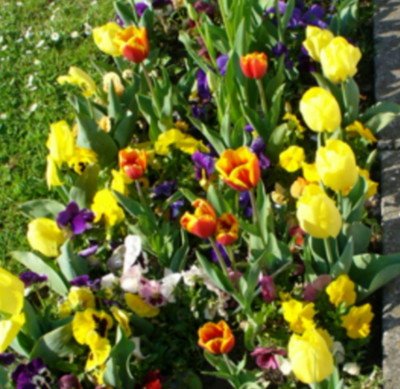
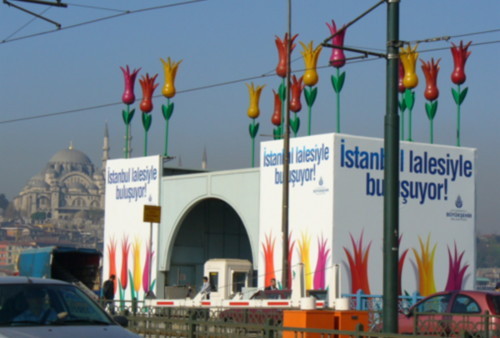
Spring has arrived in Istanbul. Birds are singing, people are strolling in the streets and there are tulips everywhere. 3 million of them.

No, I didn’t count them. As prolific as the flowers, posters have sprung up all over the city claiming “Istanbul Meets Its Tulip-3 million tulips opening at once”.

When most people think of tulips, they think of the Netherlands. But the bulbous flower actually has its roots in Central Asia. It’s the national flower of Iran as well as Turkey, and has been the symbol of Istanbul for centuries.

Tulips are a well-known motif from the Ottoman period, appearing in all forms of art including painting, calligraphy, embroidery and ceramics.

The flower was brought to Holland from Turkey in the 17th century and set off a craze known as Tulip Mania, where people were bidding exorbitant amounts for a single bulb. Turkey had its own sort of Tulip Mania in the first half of the 18th century called the Tulip Period. A peaceful era for the Empire, and a time when arts and culture flourished, courtesans took to building villas with tulip gardens. It got to be a case of trying to outdo the Joneses (or the Ahmets as it were) as they would try to build bigger gardens with more varieties of tulips then their neighbors. It’s estimated that there were close to 100 varieties of tulip at the height of the Tulip Period.

While Istanbul certainly hasn’t returned to its former glory this spring, it’s nice to see the city make an effort to revive interest in part of Istanbul’s cultural heritage. Besides 3 million flowers, there are tulip exhibitions and tulip conferences. And in case people didn't realize tulip season is upon us, there's brightly-colored 6 meter high fiberglass tulips on top of Galata Bridge that light up at night and greet people coming in and out of the city.

I don’t think many tourists came to Istanbul this year just to take part in the ‘TulipFest’, but it’s nice to think that ‘Tulip Tourism’ could be a new market in the near future, and that Turkey could reclaim the tulip as its own.


Labels: , ,